Jojoba Oil vs Argan Oil: Which One Does Your Skin Need?
Published 2026-08-07 by Rose Petal Glam
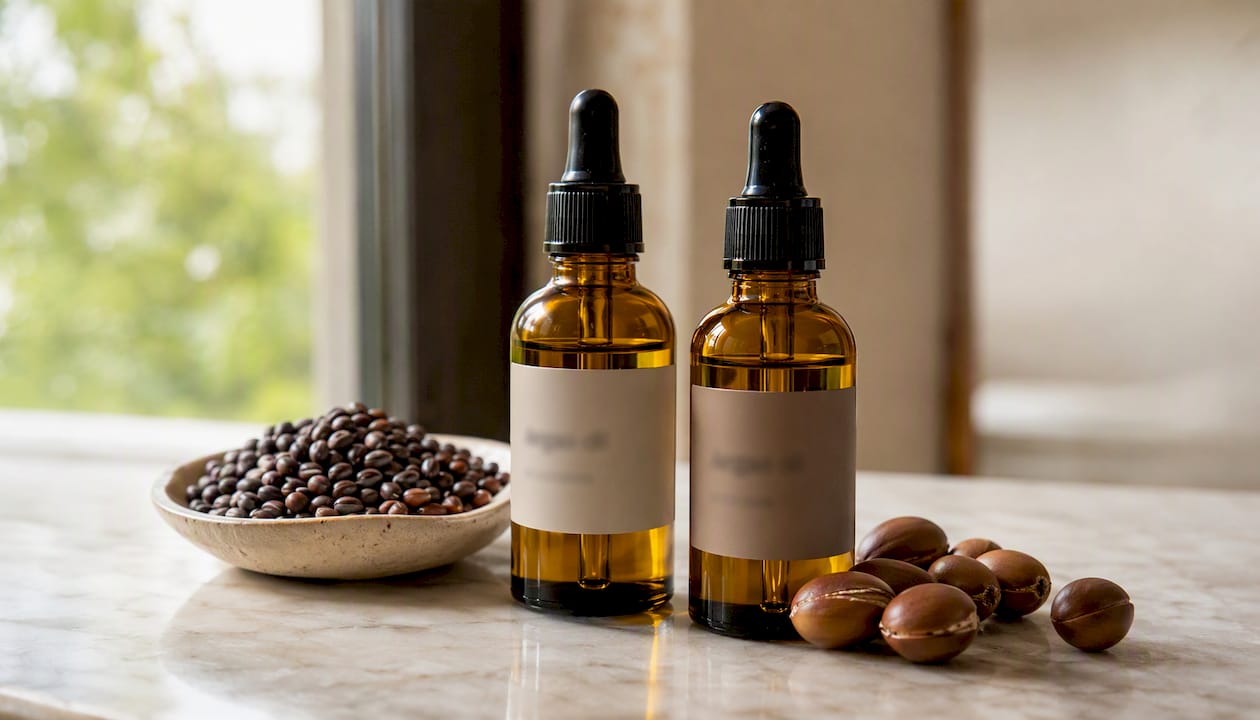
For oily, combination, or acne-prone skin, jojoba is the smarter pick. For very dry skin, damaged hair, or mature skin that needs serious moisture, argan delivers more. That’s the short version of the jojoba oil vs argan oil debate, and most people can stop there.
If you want the longer version, here it is.
- Face (oily or combination skin): Use jojoba. Its chemistry mirrors your skin’s own sebum, so it absorbs without clogging pores.
- Hair (dry, damaged ends or frizz control): Use argan. Its fatty-acid density smooths the cuticle and repairs moisture loss.
- Daily body routine or sensitive skin: Either works, but jojoba tends to cause fewer reactions and layers better under moisturizer.
Both oils can be blended together. A 1:1 mix covers most combination needs, and neither oil is so heavy it cancels the other out.
Key Takeaways
Jojoba suits oily, combination, and sensitive skin best; argan is the stronger choice for very dry skin, damaged hair, and mature skin that needs antioxidant repair.
| Point | Details |
|---|---|
| Skin-type match rule | Choose jojoba for oily or acne-prone skin; choose argan for dry, mature, or barrier-damaged skin. |
| Hair-type match rule | Use argan on dry or damaged ends for frizz control; use jojoba on the scalp for sebum balance. |
| Patch test first | Apply to inner elbow and wait 24–48 hours before using either oil on your face or body. |
| Storage matters | Store both oils in dark glass away from heat and light; jojoba lasts roughly 2 years, argan 12–18 months. |
| Rosepetalglam option | Rosepetalglam’s whipped body butters combine jojoba with tallow in a pre-formulated, small-batch blend for consistent results. |
Table of Contents
- How do jojoba oil and argan oil compare side by side?
- What are jojoba oil and argan oil, exactly?
- What’s actually inside each oil?
- Which oil suits your skin type?
- How does each oil perform for hair?
- How do you actually use these oils?
- Are there any safety risks or side effects?
- How do you pick a quality oil and store it properly?
- What do dermatologists say about choosing between these oils?
- An editorial perspective on which oil actually matters more
- Rosepetalglam’s jojoba-infused body butters are worth trying
- Sources
- FAQ
How do jojoba oil and argan oil compare side by side?
| Feature | Jojoba Oil | Argan Oil |
|---|---|---|
| Best for (skin) | Oily, combination, acne-prone, sensitive | Dry, mature, normal |
| Best for (hair) | Scalp balance, lightweight conditioning | Dry/damaged ends, frizz control, shine |
| Texture & absorption | Lightweight, fast-absorbing liquid wax | Slightly richer, absorbs well but slower |
| Main actives | Wax esters, sterols, vitamin E | Oleic acid, linoleic acid, tocopherols, phenols |
| Comedogenic risk | Very low (rating: 2) | Low (rating: 0–1) |
| Typical uses | Face serum, scalp treatment, carrier oil | Night repair, hair serum, body oil |
| Scent | Faint, nutty, nearly odorless | Mild, slightly nutty |
| Price/availability | Moderate to high; widely available | Moderate; widely available |
Three things to look for when buying either oil:
- Cold-pressed on the label means heat was not used during extraction, preserving the most active compounds.
- 100% pure or single-ingredient rules out dilution with cheaper carrier oils.
- Cosmetic-grade confirms the oil was processed for skin use, not industrial applications.
When a formulated product makes more sense than neat oil: if you want added actives (hyaluronic acid, retinol, peptides), consistent dosing, or a product that won’t separate, a well-made body butter or serum that contains jojoba or argan gives you the oil’s benefits inside a stable, ready-to-use formula.
What are jojoba oil and argan oil, exactly?
Jojoba (Simmondsia chinensis) is native to the Sonoran Desert of the southwestern United States and northwestern Mexico. The oil is cold-pressed from the seeds of the jojoba shrub. Technically, it is not an oil at all. It is a liquid wax ester, which is a key chemical distinction that explains almost everything about how it behaves on skin: it does not oxidize the way triglyceride oils do, it resists rancidity, and it sits on and in the skin in a way that closely resembles the skin’s own sebum.
Argan (Argania spinosa) comes from the kernels of the argan tree, which grows almost exclusively in southwestern Morocco. The oil is also cold-pressed, though traditional hand-extraction methods still exist. Unlike jojoba, argan is a true triglyceride oil, meaning its structure is built from fatty acids attached to a glycerol backbone. Cold-pressing matters here too: heat processing degrades the tocopherols and phenolic compounds that give argan much of its antioxidant value, as research on plant-oil extraction confirms.
The wax-ester vs. triglyceride distinction is not just chemistry trivia. Wax esters are more oxidatively stable and absorb differently through the skin barrier. Triglyceride oils carry more fatty-acid diversity, which drives argan’s deeper moisturizing and repair effects.
What’s actually inside each oil?
The functional differences between these two oils come down to their molecular makeup.
Jojoba’s key components:
- Wax esters (more than 98% of its composition), which mimic human sebum and support the skin barrier
- Sterols, which have mild anti-inflammatory properties
- Vitamin E (tocopherols), contributing antioxidant protection
- Exceptional oxidative stability because wax esters do not break down the way unsaturated fatty acids do
Argan’s key components:
- Oleic acid (monounsaturated, a significant portion of total fatty acids) for deep moisture and softness
- Linoleic acid (polyunsaturated, a substantial portion) for barrier repair and anti-inflammatory support
- Tocopherols reported in notable amounts per 100 g in some analyses, making it one of the richer plant sources of vitamin E
- Phenolic compounds that add antioxidant and anti-aging activity
A scientific review of argan oil’s composition confirms the oil is high in both monounsaturated and polyunsaturated fatty acids and tocopherols, which together support its moisturizing and antioxidant actions for skin and hair.
| Component | Jojoba | Argan |
|---|---|---|
| Primary structure | Wax esters (>98%) | Triglycerides |
| Oleic acid | Trace | a significant portion |
| Linoleic acid | Trace | a substantial portion |
| Vitamin E (tocopherols) | Present; moderate | notable amounts per 100 g |
| Phenolic compounds | Minimal | Present |
| Oxidative stability | Very high | Moderate |
The practical takeaway: jojoba’s stability makes it a superior carrier and long-shelf-life product. Argan’s fatty-acid richness makes it more effective at repairing a compromised moisture barrier.
Which oil suits your skin type?
Jojoba for skin
Jojoba’s sebum-like chemistry means it absorbs quickly without leaving a greasy film. Cleveland Clinic notes that its resemblance to human sebum contributes to broad compatibility and low irritation risk, which is why it shows up in formulas for nearly every skin type.
Jojoba works best for:
- Oily and combination skin (regulates without over-stripping)
- Acne-prone skin (low comedogenic rating, anti-inflammatory sterols)
- Sensitive skin, including conditions like eczema or rosacea
- Everyday face and body use as a lightweight moisturizer or carrier
Argan for skin
Argan’s higher fatty-acid content makes it richer and more occlusive. Verywell Health describes it as effective for restoring the skin barrier and retaining moisture, particularly for dry skin types.
Argan works best for:
- Dry and very dry skin (body and face)
- Mature skin that has lost elasticity and moisture
- Normal skin looking for antioxidant protection and glow
- Post-sun or wind-damaged skin that needs barrier repair
Pro Tip: Start with a patch test on the inside of your forearm. Apply a few drops, wait 24–48 hours, and check for redness, itching, or breakouts before using either oil on your face. For jojoba oil for sensitive skin specifically, the natural ingredients guide at Rosepetalglam walks through how to layer gentle actives safely.
For oily skin, the AAD recommends lighter, non-comedogenic options, which is exactly where jojoba fits. Argan, despite its low comedogenic rating, is richer and better reserved for drier zones or drier skin types overall.
How does each oil perform for hair?
Argan for hair
Argan is the go-to for dry, color-treated, or heat-damaged hair. Its oleic and linoleic acids penetrate the hair shaft and smooth the cuticle, reducing frizz and adding shine. A few drops on damp ends before styling works as a lightweight heat protectant. As a pre-shampoo mask, apply generously from mid-lengths to ends, leave for 20–30 minutes, then shampoo out. For argan oil for hair, this pre-wash treatment is where it earns its reputation.
Jojoba for scalp
Jojoba’s sebum-mimicking chemistry makes it the better choice for scalp work. It can help balance oil production on a greasy scalp without triggering more sebum, and its anti-inflammatory sterols may calm a flaky or irritated scalp. Massage 4–6 drops into the scalp, leave for 15–20 minutes, then wash out. Because it absorbs cleanly, it is less likely than argan to weigh down fine hair.
A note on fine hair: applying either oil directly to roots or leaving large amounts on fine hair can make it look limp. For fine or low-porosity hair, use 1–2 drops max on ends only, or opt for a formulated product where the oil concentration is already calibrated.
How do you actually use these oils?
For the face
- Cleanse and tone as usual.
- While skin is still slightly damp, warm 2–3 drops of your chosen oil between your palms.
- Press gently onto face. Do not rub aggressively.
- Follow with moisturizer if needed, or use the oil as your final step at night.
- For oily or combination skin, use jojoba in the AM. For dry or mature skin, argan works well as a PM repair step.
For the body
- Apply to damp skin right after a shower for best absorption.
- Use 4–8 drops for arms and legs; more for very dry areas like elbows and knees.
- Argan is the better choice for the best oil for dry skin body use, especially in winter. Jojoba works well year-round for normal to oily body skin.
For the scalp and hair
- Scalp treatment: 4–6 drops of jojoba massaged in, left 15–20 minutes, then shampooed out.
- Pre-shampoo hair mask: argan applied mid-length to ends, 20–30 minutes, then wash.
- Leave-in finishing: 1–2 drops of argan on dry ends to smooth frizz.
Simple blending recipes
- Combo skin face oil: 1:1 jojoba and argan (3 drops each). Jojoba controls shine; argan adds antioxidant depth.
- Dry hair serum: 100% argan, 2–3 drops on damp ends before heat styling.
- Scalp + length treatment: 70% jojoba, 30% argan. Covers scalp balance and mid-length moisture in one step.
Who should avoid neat oil or dilute further:
- Anyone with a known nut allergy (see safety section below)
- People using topical prescription retinoids or corticosteroids (oil can alter absorption)
- Those with very acne-prone skin who have not patch-tested first
- Anyone with open wounds, active eczema flares, or broken skin
For a full clean skincare routine that incorporates natural oils safely, Rosepetalglam’s blog covers layering order and frequency in detail.
Are there any safety risks or side effects?
Both oils are well tolerated by most people, but “natural” does not mean risk-free.
Patch test instructions: Apply a small amount to the inside of your elbow or behind your ear. Leave it for 24–48 hours without washing. If you see redness, swelling, itching, or small bumps, do not use the oil on your face or body.
Comedogenicity: Jojoba rates around 2 on the standard comedogenic scale (0–5). Argan rates 0–1. Both are considered low-risk for clogging pores, though individual responses vary. Research confirms that contact dermatitis from jojoba is uncommon, and it is generally listed as low-comedogenic in formulation literature.
Red-flag reactions to stop use immediately:
- Hives, rash, or significant redness spreading beyond the application site
- Swelling, especially around the eyes or lips
- Itching that worsens over several hours
- Any sign of a systemic allergic reaction (difficulty breathing, throat tightness)
Argan and nut allergies: Argan is derived from a tree nut. If you have a documented tree-nut allergy, consult a dermatologist or allergist before applying argan oil topically. Topical exposure is different from ingestion, but cross-reactivity is possible.
Prescription topical medications: If you use prescription retinoids, antibiotics, or corticosteroids on your skin, apply those first and allow them to absorb fully before adding any oil. Oils can act as occlusive layers that alter how medications penetrate the skin.
How do you pick a quality oil and store it properly?
Labels that matter:
- Cold-pressed: preserves fatty acids, tocopherols, and phenolic compounds that heat destroys
- Unrefined: retains more of the natural color, scent, and active compounds; refined versions are more neutral but may have lower nutrient content
- 100% pure / single-ingredient: no dilution with cheaper oils like sunflower or mineral oil
- Cosmetic-grade: processed for skin application, not food or industrial use
Rancidity checks before you use:
- Jojoba should be pale golden and nearly odorless; a strong, sour, or paint-like smell means it has oxidized
- Argan should be golden to amber with a mild nutty scent; rancid argan smells sharp or crayon-like
- Cloudiness in jojoba at room temperature is normal (it is a wax and can solidify slightly in the cold); cloudiness in argan at room temperature is a quality concern
Storage:
- Store both oils in dark glass bottles away from direct light and heat
- Keep caps tightly sealed to limit air exposure
- A cool, dark cabinet is sufficient; refrigeration is optional but extends life
Shelf life: WebMD notes that jojoba resists rancidity due to its wax-ester chemistry and antioxidant content, giving it a shelf life of roughly 2 years or more when stored properly. Argan, as a triglyceride oil, is more susceptible to oxidation; expect 12–18 months from opening. Formulated products that contain these oils in a stabilized base typically carry a manufacturer-stated expiry and last longer once opened than neat oil does.
What do dermatologists say about choosing between these oils?
Dermatologists consistently frame the choice around skin need rather than a universal winner.
Board-certified dermatologists advise matching oil weight to skin type: heavier oils for dry or mature skin, lighter oils for oily or acne-prone skin. The AAD’s guidance on oily skin reinforces this, recommending lighter, non-comedogenic options rather than richer formulas that can tip the balance toward congestion.
For practical use: if your skin is dry in winter and oily in summer, keep both on hand and rotate. Jojoba for warm months and oily zones; argan for dry patches, cold weather, and hair repair.
An editorial perspective on which oil actually matters more
The jojoba vs argan conversation gets more complicated than it needs to be online. Most articles treat it as a binary choice, but the more useful question is: what is your skin actually missing?
Argan gets a lot of attention because it photographs beautifully on hair and the “liquid gold” branding is compelling. But for the majority of people who have normal-to-oily skin and are not dealing with severely damaged hair, jojoba is the more versatile daily workhorse. It absorbs faster, lasts longer on the shelf, and causes fewer reactions. The fact that its chemistry mirrors human sebum is not a marketing claim; it is a documented structural similarity that explains why it works across such a wide range of skin types.
What gets underestimated is the value of a well-formulated product over neat oil for most people. A single-ingredient oil gives you control, but it also gives you the full burden of getting the application right: the right amount, the right timing, the right layering order. A small-batch formulation that combines jojoba with tallow, shea, or other actives in calibrated ratios does that work for you. That is not a compromise. For most people, it is the smarter starting point.
Rosepetalglam’s jojoba-infused body butters are worth trying
If you want jojoba’s benefits without measuring drops and worrying about layering order, Rosepetalglam’s whipped body butters combine jojoba oil with grass-fed beef tallow and other skin-nourishing ingredients in a ready-to-use formula. Each batch is made in small quantities in Mount Morris, Michigan, which means you get a product where ingredient quality is traceable, not assumed.

The difference between a neat oil and a formulated butter is consistency: the butter delivers jojoba’s sebum-balancing and barrier-supporting properties alongside tallow’s fatty-acid richness, in a ratio that has already been tested for skin feel and absorption. For sensitive skin, the fragrance-free options remove one more variable. Browse the tallow skincare collection to find the right fit for your skin type, or start with a single whipped body butter to see how your skin responds.
Sources
FAQ
Is jojoba oil better than argan oil for most people?
For everyday use across a range of skin types, jojoba is more versatile. Its sebum-like chemistry suits oily, combination, and sensitive skin, while argan is the stronger pick specifically for very dry skin or damaged hair.
Who should not use jojoba oil?
Anyone with a known allergy to jojoba should avoid it, though reactions are uncommon. People using prescription topical medications should apply those first and allow full absorption before adding any oil layer.
Can you use argan oil and jojoba oil together?
Yes. A 1:1 blend works well for combination skin and hair that needs both scalp balance and end moisture. Mix them in your palm before applying, or blend in a small dropper bottle for daily use.
What is the best oil for hair growth?
No single oil is clinically proven to stimulate hair growth. Jojoba supports a healthy scalp environment by balancing sebum, and argan’s fatty acids nourish the hair shaft, but neither replaces medical treatment for hair loss. Consult a dermatologist if hair loss is a concern.
Recommended
- Why Grass-Fed Beef Tallow Skincare Is Taking Over in 2026 | Rose Petal Glam Blog
- Why Grass-Fed Beef Tallow Is the Best Kept Secret in Skincare | Rose Petal Glam Blog
- The Ultimate Guide to Natural Ingredients for Sensitive Skin | Rose Petal Glam Blog
- Cold Process Soap vs. Store-Bought: What You’re Really Putting on Your Skin | Rose Petal Glam Blog