What Does “Clean Beauty” Actually Mean? How to Read Body-Care Labels Without Fear
Published 2026-09-24 by Roseann Zelenka
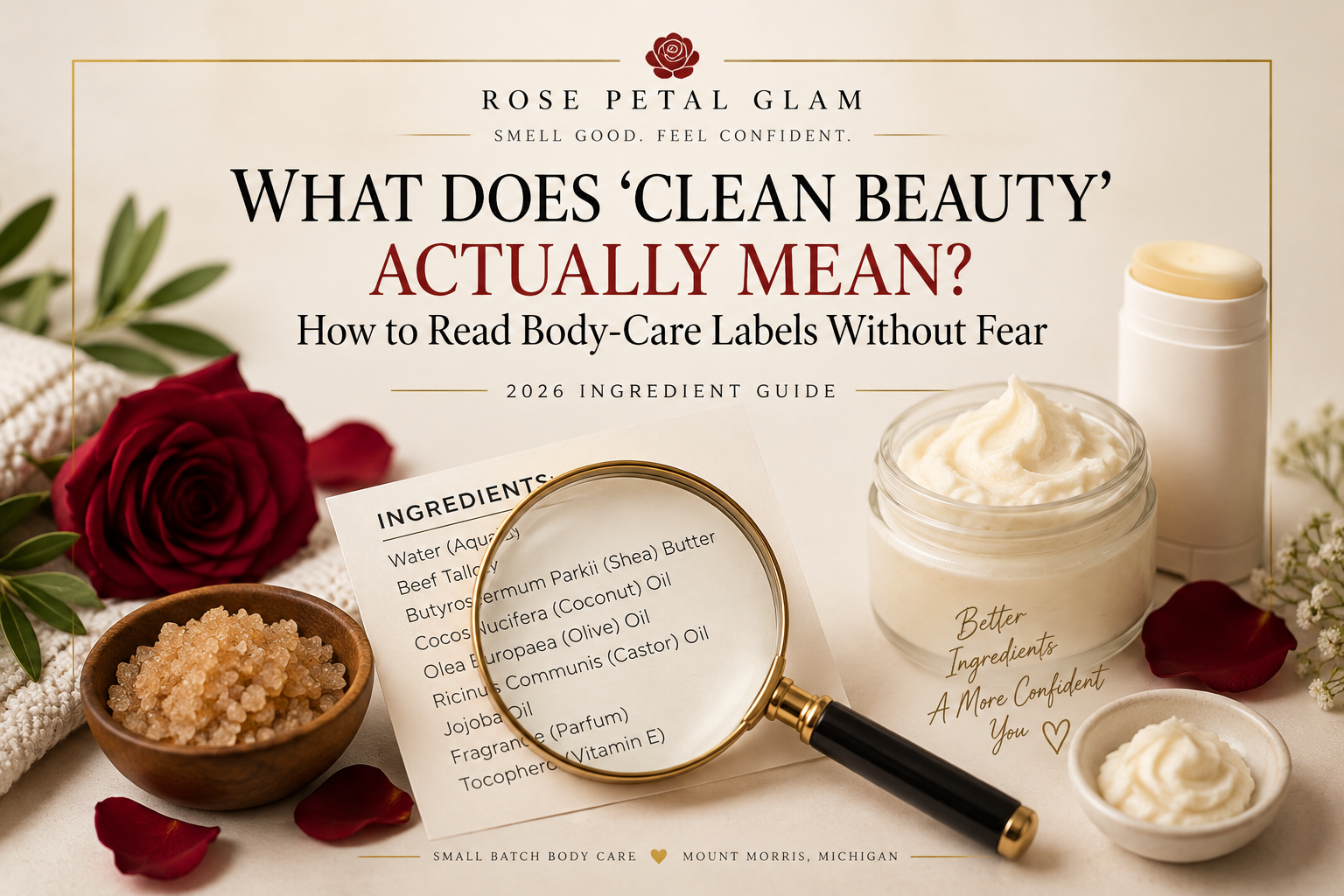
“Clean beauty” does not have one universal regulatory definition in the United States. A product labeled clean, natural or green is not automatically safer than another cosmetic—and a long ingredient name does not automatically make an ingredient dangerous.
If you've ever turned over a body butter, deodorant or scrub and stared at the ingredient list wondering whether you should recognize every word, you're definitely not alone.
Beauty shoppers have become ingredient readers.
That's mostly a good thing.
Knowing what you're buying can help you compare products, avoid ingredients you personally don't want and make more informed decisions.
But ingredient awareness has also created a new problem:
Fear has become a marketing strategy.
Words such as “clean,” “natural,” “toxin-free,” “chemical-free” and “non-toxic” can make one product sound inherently safe and another sound dangerous—even when those words don't tell you enough to reach either conclusion.
So let's remove the fear and learn how body-care labels actually work.
Quick Answer: What Does Clean Beauty Mean?
There is no single government definition of “clean beauty” that all cosmetic companies in the United States must follow.
Individual brands, retailers and publications can create their own clean-beauty standards.
That means two products labeled “clean” may follow completely different ingredient rules.
Instead of treating “clean” as a safety certification, use it as a reason to ask the next question:
What does this particular company mean when it says clean?
The Clean-Beauty Label Decoder
| Label or Claim | What It Can Tell You | What It Does NOT Automatically Prove |
|---|---|---|
| Clean | The brand or retailer follows its own ingredient standard | That the product is universally safer |
| Natural | Usually indicates a brand's ingredient philosophy | That every ingredient is safer or non-irritating |
| Organic | May relate to certified agricultural ingredients when applicable | That the finished cosmetic is automatically safer |
| Fragrance-free | No fragrance has been intentionally added for scent | That no ingredient could ever irritate anyone |
| Aluminum-free deodorant | The deodorant does not use aluminum antiperspirant actives | That it will stop perspiration |
| Preservative-free | No conventional preservative system may be present | That preservation is unnecessary in every formula |
| Handmade | Describes how a product is produced | That it is automatically safer or more effective |
| Small batch | Describes production scale | That every small-batch formula is superior |
Why Is Clean Beauty Trending Again in 2026?
Ingredient literacy has moved beyond facial skincare.
Consumers are now reading labels on deodorant, body wash, moisturizer, body spray and other everyday body-care products.
September 2026 trend data shows particularly strong interest around clean-label beauty and aluminum-free deodorant.
Meanwhile, Allure's 2026 Best of Beauty Clean category put ingredient transparency directly at the center of the conversation.
Allure acknowledges something particularly important: there is no universal clean standard.
It therefore created its own published ingredient criteria for products competing in its Clean category.
That's a much more useful approach than simply printing “clean” on a package and expecting consumers to know what it means.
Does the FDA Define “Natural” Cosmetics?
No.
The U.S. Food and Drug Administration says it has not established a regulatory definition for the word “natural” in cosmetic labeling.
That's important because “natural” is one of the most powerful words in beauty marketing.
People understandably associate nature with simplicity.
But natural origin and safety are two different questions.
Plants can contain allergens.
Natural fragrance materials can irritate susceptible skin.
Minerals can contain contaminants.
And synthetic ingredients can be thoroughly characterized and safely used in cosmetic formulas.
Where an ingredient comes from does not, by itself, tell you whether it is safe.
Does Organic Mean Safer?
No. Organic describes how qualifying agricultural ingredients are produced; it is not a universal cosmetic-safety rating.
The FDA specifically says that cosmetics made with ingredients labeled organic are not automatically safer than cosmetics made with ingredients from other sources.
USDA's National Organic Program oversees qualifying organic agricultural claims, while cosmetic products remain subject to applicable cosmetic safety and labeling requirements.
So “organic” can absolutely matter if agricultural sourcing is important to you.
It just shouldn't be translated into “everything else is toxic.”
What About the Word “Non-Toxic”?
This term sounds reassuring because nobody wants toxic body care.
But toxicity depends on factors including the substance, concentration, route of exposure and dose.
Simply describing one cosmetic as “non-toxic” can imply competing products are toxic without providing meaningful context.
A more useful approach is to make specific, truthful statements about what a formula contains or does not contain.
Can Cosmetics Really Be “Chemical-Free”?
No—not literally.
Water is a chemical substance.
Sugar is composed of chemicals.
Jojoba wax consists of chemical compounds.
Beef tallow contains triglycerides and fatty acids.
The fragrance molecules responsible for the smell of a rose are chemicals.
So are the molecules responsible for the smell of vanilla.
“Chemical” is not another word for “dangerous.”
Everything you can physically put into a cosmetic is made of matter with a chemical composition.
Natural vs. Synthetic: Which Is Better?
Neither category automatically wins.
A naturally derived ingredient can be excellent.
A synthetic ingredient can be excellent.
Either can also be inappropriate in a poorly designed formula.
The better questions are:
- What is the ingredient?
- Why is it in the formula?
- At what concentration is it used?
- Is the product intended to be rinsed off or left on?
- Is the finished product appropriately formulated?
- Does your own skin tolerate it?
The Ingredient List Is More Useful Than the Front Label
The front of a cosmetic package is where marketing lives.
The ingredient declaration is where you can start understanding the formula.
For cosmetics sold in the United States, ingredients are generally listed using their required common or usual names according to applicable labeling rules.
Learning a few label-reading principles is more useful than trying to memorize a viral “bad ingredient” list.
How to Read a Body-Care Ingredient List
Step 1: Identify What Kind of Product It Is
A cleanser should not be judged by the same criteria as a leave-on body butter.
A deodorant has a different job from a moisturizer.
A fragrance spray has a different job from a sugar scrub.
Always start with intended use.
Step 2: Look at the First Several Ingredients
Ingredients present at higher concentrations generally appear earlier in a cosmetic ingredient declaration, subject to labeling rules for lower-level ingredients and color additives.
This can help you understand the foundation of the formula.
Step 3: Don't Panic Over Scientific Names
Simmondsia Chinensis Seed Oil may sound intimidating if you don't recognize it.
It's jojoba oil.
Tocopherol is vitamin E.
Sucrose is sugar.
Scientific or standardized ingredient naming makes labels more precise; it doesn't make the ingredients dangerous.
Step 4: Look for Ingredients Relevant to YOU
If you know fragrance irritates your skin, fragrance matters.
If you have a known allergy, that ingredient matters.
If you're vegan, animal-derived ingredients matter.
If you want an antiperspirant rather than deodorant, an approved antiperspirant active matters.
Your priorities are more useful than someone else's viral blacklist.
Step 5: Consider the Whole Formula
An ingredient list isn't simply a collection of heroes and villains.
Ingredients work together to create texture, stability, cleansing, fragrance, preservation and skin feel.
Why Does Water Change a Cosmetic Formula?
This is one of the most important formulation concepts consumers rarely hear explained.
Products containing water generally require appropriate protection against microbial contamination.
Water creates an environment in which microorganisms may grow if the formula isn't properly protected.
That is why preservatives exist.
They're not automatically evidence of a “dirty” formula.
They're often part of making a water-containing cosmetic safe and stable during normal use.
Are Preservatives Bad?
No, preservatives are not automatically bad.
In products that can support microbial growth, an effective preservation system can be an important safety feature.
A poorly preserved water-containing cosmetic is not somehow safer because the ingredient list looks more natural.
This is where understanding formulation beats ingredient fear.
Why Doesn't Every Body Butter Need the Same Preservative System?
Formula type matters.
Rose Petal Glam's current Whipped Tallow Body Butter is anhydrous, meaning the formula does not contain a water phase.
That is fundamentally different from a conventional water-based lotion.
It does not mean that every water-free product in existence can ignore contamination, manufacturing hygiene, oxidation, storage or product-specific safety considerations.
It simply means preservation requirements depend on the actual formula.
What Does “Fragrance-Free” Actually Help You Decide?
Fragrance-free is a much more specific shopping preference than “clean.”
If you know added fragrance bothers your skin—or you simply don't want to smell like anything—a fragrance-free product gives you useful information.
Rose Petal Glam offers Gentle Clean fragrance-free body care for customers who prefer that option.
That doesn't mean scented body care is automatically unsafe.
It means customers deserve a choice.
Does Fragrance Automatically Make a Product “Dirty”?
No.
Fragrance is a legitimate cosmetic ingredient category.
Many consumers actively choose scented body products because fragrance is part of the experience they want.
Other people avoid fragrance because of preference, sensitivity or allergy.
Both choices are reasonable.
Rose Petal Glam makes fragrance-inspired body care while also offering Gentle Clean fragrance-free options.
Ingredient transparency means explaining that choice—not pretending one group is smarter than the other.
What Does Aluminum-Free Deodorant Mean?
It means the product does not use aluminum antiperspirant actives. It does not mean the product stops perspiration.
Deodorant and antiperspirant have different jobs.
Deodorant addresses odor.
Antiperspirant reduces sweating using approved active ingredients, commonly aluminum salts.
Rose Petal Glam's tallow deodorant is aluminum-free and intended for odor management.
We don't need to claim aluminum is poisonous or dangerous to explain why someone may prefer an aluminum-free deodorant.
Does “Free From” Automatically Mean Better?
No.
A claim such as “free from X” is useful when X is something you specifically want to avoid.
But removing an ingredient does not automatically improve a formula.
The replacement matters too.
For example, “preservative-free” sounds appealing until you ask whether the product contains enough water to require microbial protection.
Good ingredient literacy asks what the entire formula is doing.
What Does Handmade Actually Mean?
Handmade describes production.
It doesn't override chemistry.
Rose Petal Glam makes its body-care products in small batches in Mount Morris, Michigan. Our cold-process soap is mixed, poured, hand-cut and cured for approximately eight to ten weeks before sale. :contentReference[oaicite:3]{index=3}
That craftsmanship is something we're proud of.
But “handmade” shouldn't be used to imply that mass-manufactured cosmetics are automatically unsafe.
Those are two separate questions.
What Does Small Batch Mean?
Small-batch manufacturing allows a maker to produce relatively limited quantities at a time.
For Rose Petal Glam, it is part of how our products are actually made—not a medical or safety claim.
You can see our process in How Rose Petal Glam Makes Handmade Body Care.
How Rose Petal Glam Uses Ingredient Transparency
Our current product lineup includes:
- Cold-process tallow soap
- Whipped tallow body butter
- Whipped tallow sugar scrub
- Aluminum-free tallow deodorant
- Premium Body Spray
- Gentle Clean fragrance-free options
- BRO'S men's grooming products
Our soap, body butter, sugar scrub and deodorant use grass-fed beef tallow.
Our Premium Body Spray is the exception: it is a fragrance product and does not contain grass-fed beef tallow.
Current ingredient lists should always be checked on the individual product page because formulas can vary by category and product.
Does Tallow Automatically Make a Product “Clean”?
No—and that isn't why we use it.
Beef tallow is an animal-derived fat used as part of Rose Petal Glam's formulation approach.
It doesn't become medically superior because it comes from an animal.
It also isn't appropriate for everyone; someone who follows a vegan lifestyle would understandably choose something else.
Our deeper evidence-based discussion is available in Beef Tallow for Skin: What It Does and Who Should Skip It.
Clean Beauty vs. Transparent Beauty
This may be the most important distinction in this entire guide.
| Fear-Based “Clean” Marketing | Ingredient Transparency |
|---|---|
| “Chemicals are bad.” | Explains what ingredients actually do. |
| “Natural means safe.” | Recognizes natural and synthetic ingredients both require appropriate use. |
| “If you can't pronounce it, don't use it.” | Recognizes standardized ingredient names can sound technical. |
| “Preservatives are toxins.” | Explains why preservation matters in formulas that support microbial growth. |
| “Aluminum-free means healthier.” | Explains deodorant vs. antiperspirant accurately. |
| “Fragrance is toxic.” | Recognizes fragrance preference and sensitivity vary by person. |
| “Handmade is always safer.” | Separates craftsmanship from safety claims. |
Rose Petal Glam would rather earn trust with the right-hand column.
The 8-Question Body-Care Label Check
Before deciding whether a product belongs in your routine, ask:
- What is this product supposed to do?
- What ingredients form the base of the formula?
- Are there ingredients I personally need or want to avoid?
- Is the product scented or fragrance-free?
- Is it rinse-off or leave-on?
- Are the marketing claims specific and believable?
- Does the company clearly disclose what is actually in the product?
- Am I choosing this because the formula fits me—or because the marketing made me afraid of everything else?
That final question is worth remembering.
Five Ingredient-Label Red Flags That Aren't Actually Red Flags
1. A Long Scientific Name
Technical naming isn't proof of danger.
2. A Synthetic Ingredient
Synthetic origin alone tells you very little about safety or performance.
3. A Preservative
Appropriate preservation can be essential in water-containing cosmetics.
4. Water as the First Ingredient
Many lotions and cleansers are intentionally water-based. Water isn't a filler simply because it appears first.
5. An Ingredient You Haven't Heard of
Unknown does not equal unsafe. Look it up using a reliable source rather than relying on a viral graphic.
Five Things That ARE Worth Paying Attention To
Ingredient literacy isn't about ignoring everything either.
Pay attention to:
- Known personal allergies
- Ingredients that have previously irritated your skin
- Whether a product is appropriate for its intended area of use
- Directions and warnings
- Unexpected changes in a product's smell, texture or appearance
If a cosmetic causes significant irritation, stop using it and seek appropriate medical advice when necessary.
Does the FDA Approve Cosmetics Before They're Sold?
Generally, no.
The FDA explains that cosmetic products and ingredients generally do not require FDA premarket approval, with the important exception of color additives.
That does not mean cosmetics are completely unregulated.
Companies marketing cosmetics have legal responsibilities concerning product safety and labeling, and products may not be adulterated or misbranded.
So “FDA approved cosmetic” and “FDA regulated cosmetic” are not interchangeable statements.
Can a Cosmetic Claim to Treat a Skin Disease?
Not as an ordinary cosmetic claim.
Intended use matters under U.S. law.
If a product is marketed as treating or preventing disease or affecting the structure or function of the body, it may be regulated as a drug rather than simply a cosmetic.
That's one reason responsible body-care companies should be cautious with claims such as:
- “Cures eczema”
- “Treats psoriasis”
- “Heals acne”
- “Repairs skin disease”
- “Detoxifies your body”
Rose Petal Glam body-care products are not presented as substitutes for medical treatment.
A Better Way to Shop Body Care
You don't need to become a cosmetic chemist.
You don't need to memorize hundreds of ingredients.
And you don't need to fear everything you can't pronounce.
Instead:
Understand the product's job. Read the ingredient list. Know your own preferences. Look for specific claims instead of vague fear language. Buy from companies willing to explain what they're making.
That's ingredient literacy.
The Bottom Line
“Clean beauty” can be a useful shopping philosophy, but it isn't a universal scientific or regulatory definition.
Natural doesn't automatically mean safer.
Synthetic doesn't automatically mean dangerous.
Preservatives aren't automatically bad.
Fragrance isn't automatically toxic.
Aluminum-free deodorant isn't the same thing as antiperspirant.
Handmade isn't a medical claim.
And an ingredient name you can't pronounce isn't automatically something you need to fear.
The strongest beauty brands shouldn't need fear to sell products.
They should be able to tell you what they make, what is in it, what it is designed to do and what it cannot promise.
That's the kind of transparency we believe body care deserves.
Explore Rose Petal Glam's small-batch body-care collection, browse Gentle Clean fragrance-free options, or learn how our products are made in Mount Morris, Michigan.
Smell Good. Feel Confident.
Frequently Asked Questions
What does clean beauty mean?
There is no single universal U.S. regulatory definition of clean beauty. Brands, retailers and publications may create their own ingredient standards, so consumers should look at the actual criteria behind the claim.
Does the FDA define natural cosmetics?
No. FDA says it has not established a regulatory definition for “natural” in cosmetic labeling.
Are natural cosmetics safer?
Not automatically. FDA states that an ingredient's source does not determine its safety. Natural ingredients can also cause irritation or allergic reactions.
Does organic mean a cosmetic is safer?
No. Organic certification relates to qualifying agricultural production standards; it does not automatically establish that a finished cosmetic is safer.
Are preservatives bad for skin?
Not inherently. Appropriate preservatives can be important for protecting water-containing cosmetics from microbial contamination.
Is chemical-free skincare possible?
No in the literal scientific sense. Water, sugar, plant oils, tallow and fragrance molecules are all made of chemical substances.
Does aluminum-free deodorant stop sweat?
No. Deodorant is intended primarily to manage odor. Antiperspirant products contain approved active ingredients designed to reduce perspiration.
Is fragrance-free always better?
No. It can be an excellent option for people who prefer no added scent or know fragrance irritates their skin, but many people comfortably use scented cosmetics.
Does handmade mean safer?
No. Handmade describes how something is produced. Safety depends on appropriate ingredients, formulation, manufacturing, labeling and intended use.
Are Rose Petal Glam products all made with tallow?
Rose Petal Glam's soap, body butter, sugar scrub and deodorant use grass-fed beef tallow. Premium Body Spray is the exception and does not contain grass-fed beef tallow.
Sources & Further Reading
- U.S. Food & Drug Administration — Small Businesses & Homemade Cosmetics
- U.S. Food & Drug Administration — “Organic” Cosmetics
- U.S. Food & Drug Administration — How Cosmetics Are Regulated
- U.S. Food & Drug Administration — Is It a Cosmetic, Drug, or Soap?
- Allure — 2026 Best of Beauty Clean Beauty Winners
This article provides general cosmetic and body-care education and is not medical advice. Individual sensitivities vary. Stop using a product that causes significant irritation and seek appropriate healthcare advice when needed.