Jojoba Oil for Skin: Benefits, Uses, and What Science Says
Published 2026-08-08 by Rose Petal Glam

Jojoba oil is one of the most broadly useful topical ingredients available, and it works for a wider range of skin types than almost any other botanical oil. The short version: it supports your skin barrier, calms inflammation, and absorbs without the greasy residue that heavier oils leave behind. Here is what you need to know before you buy.
Top benefits: barrier support, soothing inflamed skin, and a sebum-like feel that works with your skin rather than against it.
Top uses: nightly face oil, body moisturizer, makeup remover, and carrier oil for blending with other actives.
Top cautions: rare contact allergy (always patch-test), and jojoba does not hydrate in the strict sense. Oils form a semi-occlusive film rather than adding water to skin, so pair it with a humectant like hyaluronic acid or glycerin for real moisture.
The sections below cover the chemistry, clinical evidence, skin-type guidance, application steps, and buying criteria in full.
Key Takeaways
Jojoba oil is a well-tolerated, evidence-backed topical ingredient that supports the skin barrier, calms mild inflammation, and suits most skin types, including oily and sensitive skin.
| Point | Details |
|---|---|
| It is a liquid wax, not an oil | Jojoba’s wax-ester structure mimics sebum, giving it stability and broad skin-type compatibility. |
| Anti-inflammatory data is promising | A 2024 ex-vivo study showed roughly 30% reduction in three inflammatory cytokines, with increased collagen and hyaluronic acid synthesis. |
| It does not hydrate on its own | Pair jojoba with a humectant like glycerin or hyaluronic acid for real moisture; jojoba seals, it does not add water. |
| Low comedogenic risk | Rated approximately 2/5, making it one of the safer oils for acne-prone and combination skin. |
| Rosepetalglam blends jojoba with tallow | The whipped body butter collection combines jojoba and grass-fed tallow for barrier support in a single small-batch product. |
Table of Contents
- What jojoba oil actually is — and why it behaves differently
- The main skin benefits of jojoba oil, and what the evidence actually shows
- Which skin types benefit most from jojoba oil?
- How to use jojoba oil on your face and body
- Safety, side effects, and how to store jojoba oil
- How to choose a quality jojoba oil
- How jojoba compares to coconut, argan, and rosehip oils
- What the scientific literature actually shows
- How Rosepetalglam uses jojoba oil in its handcrafted products
- An honest take on jojoba oil
- Rosepetalglam’s jojoba-infused body butter is worth trying
- Sources
- FAQ
What jojoba oil actually is — and why it behaves differently
Most facial oils are triglycerides: three fatty acid chains attached to a glycerol backbone. Jojoba is not. A peer-reviewed review published in PMC classifies Simmondsia chinensis seed oil as primarily long-chain wax esters (C20–C22), making it chemically closer to human sebum than to any common vegetable oil. That distinction drives almost every practical advantage the oil has.
Why the wax-ester structure matters:
- Sebum compatibility: Your skin’s natural oil is also wax-ester-dominant, which is why jojoba blends into the skin surface without the occlusive heaviness of shea or coconut oil.
- Oxidation stability: Wax esters resist rancidity far better than polyunsaturated triglycerides. A properly stored bottle of cold-pressed jojoba typically stays stable for two years or more, and it can actually extend the shelf life of blends that include oxidation-prone oils like rosehip.
- Semi-occlusive film: The wax-ester structure forms a breathable layer that slows transepidermal water loss (TEWL) without fully sealing the skin. That is the practical reason it suits both dry and oily skin types.
Jojoba is cold-pressed from the seeds of the Simmondsia chinensis shrub, native to the Sonoran Desert. Cold-pressing preserves the tocopherols (vitamin E) and wax-ester integrity. Refined or solvent-extracted versions are lighter in color and odor but may have lower tocopherol content. For skincare, cold-pressed is the better choice.
The main skin benefits of jojoba oil, and what the evidence actually shows
The Cleveland Clinic notes that dermatologists find jojoba broadly useful for moisturizing, soothing inflamed skin, and supporting oily or acne-prone skin, based on clinical experience and its sebum-like chemistry. Here is how each benefit works and how well it is supported.
- Barrier support and reduced TEWL: The semi-occlusive wax-ester film slows water evaporation from the skin surface. This is the most mechanistically straightforward benefit and the one with the clearest rationale.
- Anti-inflammatory effects: A 2024 ex-vivo study published in Frontiers in Pharmacology found that topical jojoba wax reduced LPS-induced IL-6, IL-8, and TNFα secretion by roughly 30% in a human skin organ culture model. It also increased pro-collagen III and hyaluronic acid synthesis. These results are promising, but ex-vivo findings do not automatically translate to clinical outcomes.
- Emollient feel: Jojoba spreads easily, absorbs without residue, and leaves skin feeling soft. This is an emollient effect, not a humectant one. It smooths the surface rather than drawing water into the skin.
- Non-comedogenic compatibility: AllerNote rates jojoba at approximately 2 out of 5 on the comedogenic scale, making it one of the lower-risk oils for acne-prone skin. Many users with oily skin tolerate it well precisely because its wax-ester structure mimics sebum without triggering excess oil production.
- Antioxidant contribution: Cold-pressed jojoba contains tocopherols (vitamin E), which provide some antioxidant protection at the skin surface. The concentration is not high enough to replace a dedicated antioxidant serum, but it adds a useful secondary benefit.
- Early ECM and collagen support: The Frontiers 2024 study also showed increased pro-collagen III synthesis in the ex-vivo model. Treat this as a promising early signal, not a proven anti-aging claim.
WebMD’s summary adds that traditional uses include wound healing and acne management, with small human studies supporting the acne application specifically.
Which skin types benefit most from jojoba oil?
Jojoba oil for sensitive skin is one of its most well-supported applications. The low comedogenic rating, non-sensitizing profile, and gentle emollient action make it a reasonable first choice for people who react to heavier oils. Here is a quick breakdown by skin type.
| Skin Type | Suitability | Notes |
|---|---|---|
| Dry | High | Use as a nightly face oil or body moisturizer; layer over a humectant |
| Normal | High | Works morning or evening; lightweight enough for daily use |
| Oily / combination | Moderate to high | Low comedogenic rating; start with 2–3 drops and observe |
| Acne-prone | Moderate | Rated ~2/5 comedogenic; patch-test first; avoid if active breakouts worsen |
| Sensitive | High | Non-sensitizing profile; fragrance-free, cold-pressed versions preferred |
| Rosacea-prone | Moderate | Anti-inflammatory data is promising; introduce slowly and watch for flushing |
For a deeper look at formulating for sensitive skin, the natural ingredients guide for sensitive skin at Rosepetalglam covers compatible ingredient pairings in more detail.
Patch-test procedure (3 steps):
- Apply a small amount (3–4 drops) to the inner forearm or behind the ear.
- Leave it unwashed for 24 hours.
- Check for redness, itching, or swelling at 24 and 48 hours before applying to the face.
Stop use and consult a dermatologist if you notice: hives, persistent redness, swelling, or a rash that spreads beyond the application site. These signs suggest contact dermatitis or a true allergy, both of which are rare but documented.
Topical jojoba is generally considered safe during pregnancy, but consult your OB-GYN before adding any new topical product if you are pregnant or nursing.
How to use jojoba oil on your face and body
Jojoba’s stability and light texture make it flexible enough for multiple roles in a routine. The key rule: apply it after water-based products, not before. Oil applied first creates a barrier that blocks water-based serums from absorbing.
1. Nightly face oil After cleansing and applying any water-based serum or toner, warm 3–5 drops between your palms and press gently into damp skin. The residual moisture helps the oil seal in hydration rather than sitting on a dry surface.
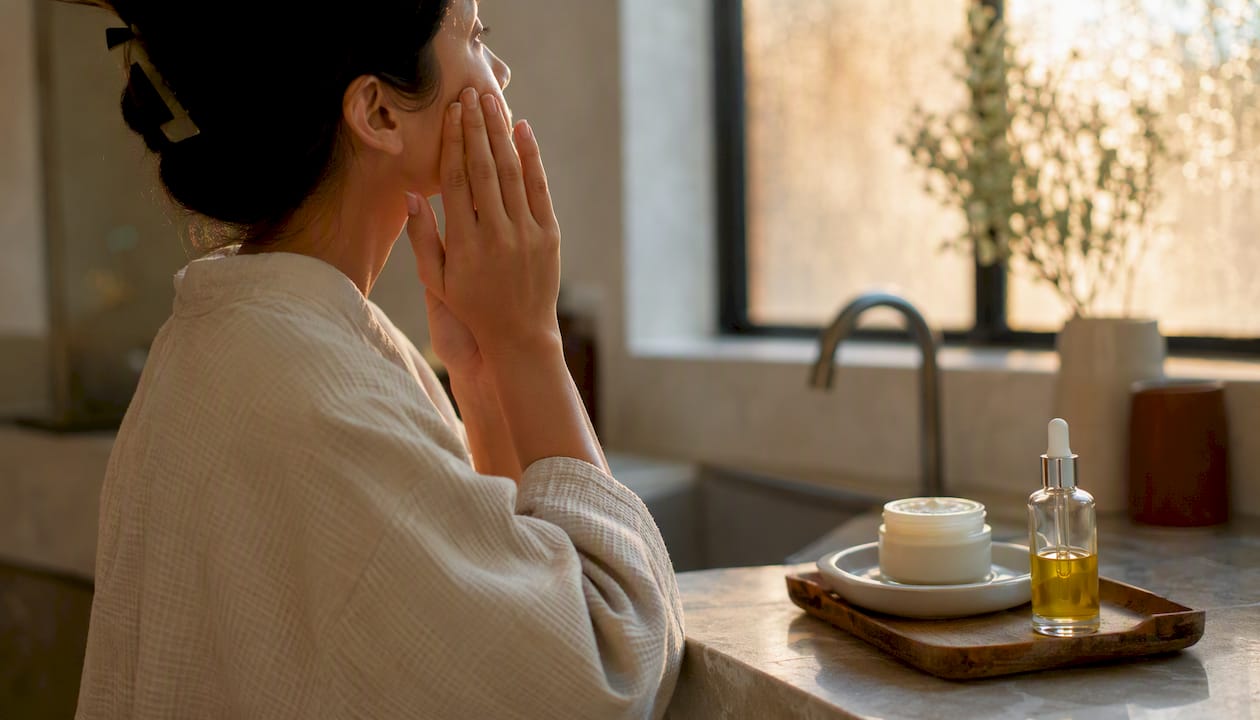
2. Morning lightweight use Use 2–3 drops mixed into your moisturizer. This keeps the texture light enough for daytime and works under SPF without pilling, provided you let each layer absorb for 60 seconds before the next.
3. Body moisturizer Apply to damp skin immediately after showering. A few drops cover a large surface area. For very dry skin, layer over a glycerin-based lotion first, then seal with jojoba.
4. Makeup removal Massage 4–6 drops onto dry skin to dissolve makeup, including waterproof formulas. Rinse with a gentle cleanser. The oil-cleansing method works because like dissolves like.
5. Scalp and hair use Warm 3–5 drops and work through the scalp or mid-lengths to ends. Leave for 20–30 minutes before shampooing. Avoid applying directly to fine hair roots if you are prone to greasiness.
Layering order: Humectant serum → jojoba oil → occlusive (if needed, e.g., tallow butter or shea) → SPF (morning only).
Pro Tip: Mixing 2–3 drops of jojoba with a glycerin-based serum before applying gives you the humectant pull of glycerin and the barrier seal of jojoba in one step. It is the simplest way to get both functions without adding an extra product layer.
Safety, side effects, and how to store jojoba oil
Jojoba is one of the safer botanical oils in cosmetic use. The Cosmetic Ingredient Review safety assessment found no strong signals for genotoxicity or carcinogenicity at typical cosmetic concentrations, and it is generally non-irritating for most users.
Realistic side effects to know:
- Contact dermatitis: Rare but documented. Usually presents as localized redness or itching at the application site. Patch-testing catches this before you apply it to your face.
- Allergic reaction: True IgE-mediated allergy to jojoba is uncommon but has been reported. Signs include hives, swelling, or difficulty breathing. Stop use immediately and seek medical attention if these occur.
- Pore congestion: The ~2/5 comedogenic rating means most people tolerate it, but a small subset with acne-prone skin may see increased breakouts. Give it 4 weeks of consistent use before concluding it works or does not.
- Ingestion risk: Jojoba is not edible. The wax esters are indigestible and can cause gastrointestinal distress. Keep it away from children and use it topically only.
- Increased penetration of other actives: Older studies suggest oils can increase skin permeability for co-applied ingredients. If you use prescription actives like tretinoin, apply jojoba at a different time of day rather than immediately after.
Storage: Keep cold-pressed jojoba in a dark glass bottle, away from heat and direct light. Shelf life under normal conditions is roughly two years. Refined jojoba is slightly more stable. A rancid oil smells waxy or crayon-like; discard it if you notice that.
How to choose a quality jojoba oil
The label tells you most of what you need to know, if you know what to look for.
| Label Feature | What to Look For | Red Flag |
|---|---|---|
| Botanical name | Simmondsia chinensis seed oil | Missing or replaced with a trade name only |
| Extraction method | Cold-pressed or expeller-pressed | “Refined” with no further detail |
| Purity | 100% jojoba oil | “Jojoba blend” without ingredient breakdown |
| Additives | None, or clearly listed | Fragrance, mineral oil, or unnamed “carrier oils” |
| Packaging | Dark glass or opaque bottle | Clear plastic bottle stored in direct light |
| Color | Golden yellow (cold-pressed) or clear (refined) | Cloudy or off-white (may indicate contamination) |
Fractionated vs. whole jojoba: True fractionated jojoba is hydrogenated into a solid wax (jojoba beads or butter) used in exfoliants and lip products. Liquid jojoba sold in skincare is the whole, unfractionated oil. If a product calls itself “fractionated jojoba oil” and is liquid, that is a marketing label, not a meaningful chemical distinction. Whole cold-pressed liquid jojoba is what you want for facial and body use.
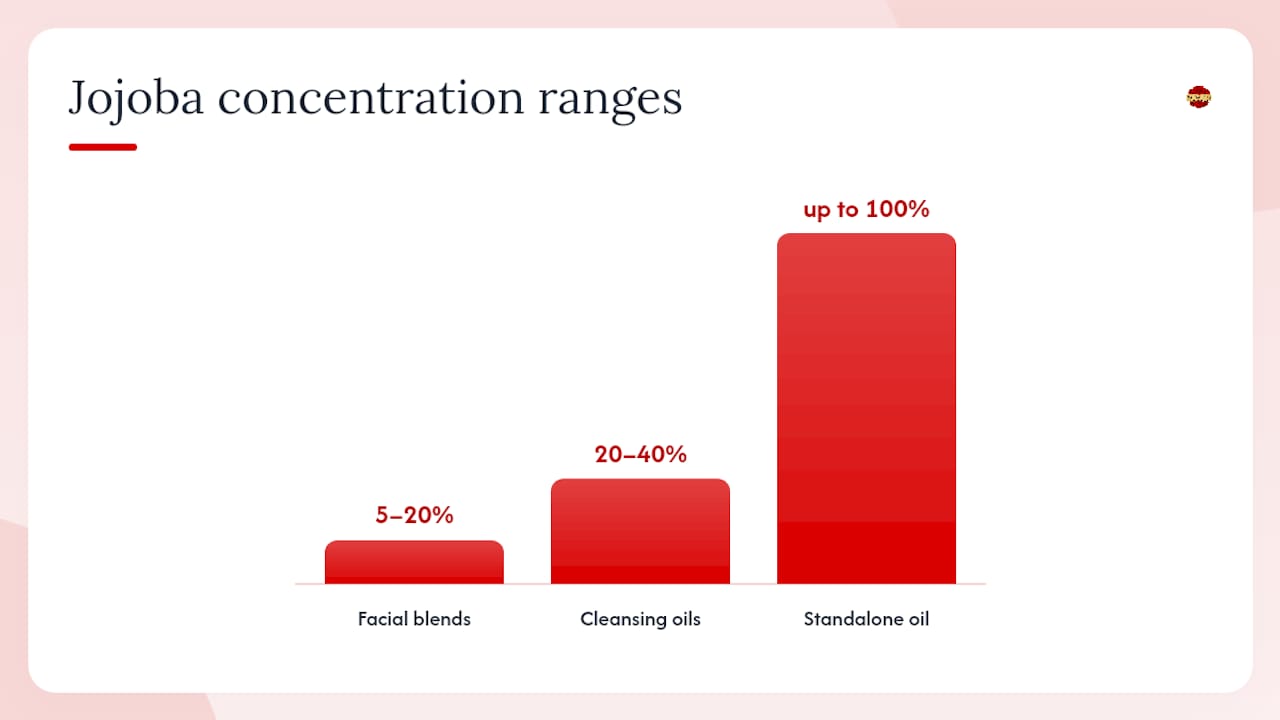
Formulation ranges to know: Ingredient formulation guidance suggests 5–20% jojoba in facial blends, 20–40% in cleansing oils, and up to 100% for standalone facial or body oil. A product listing jojoba far down an ingredient list (after water, glycerin, and several other oils) contains very little of it.
Pro Tip: Cold-pressed jojoba has a faint, nutty scent. If a bottle labeled “cold-pressed” is completely odorless, it has likely been deodorized through additional processing. That is not dangerous, but it is not truly cold-pressed.
How jojoba compares to coconut, argan, and rosehip oils
The right oil depends on your skin goal. Here is where jojoba stands relative to the three most commonly compared alternatives.
Jojoba vs. coconut oil: Coconut oil rates around 4/5 on the comedogenic scale, which is why it frequently triggers breakouts in acne-prone skin. Jojoba rates approximately 2/5. For oily or combination skin, jojoba is the safer default. Coconut oil has its place as a heavy occlusive for very dry body skin or as a hair mask, but it is a poor choice for facial use in most people.
Jojoba vs. argan oil: Argan is a triglyceride oil rich in oleic and linoleic acids, with a higher tocopherol content than jojoba. It has a stronger antioxidant profile and is often preferred for anti-aging routines. Jojoba wins on stability and sebum compatibility; argan wins on essential fatty acid content. They layer well together.
Jojoba vs. rosehip oil: Rosehip is high in linoleic acid and trans-retinoic acid precursors, which gives it a stronger regenerative reputation for hyperpigmentation and scarring. It is also significantly more prone to oxidation. Mixing jojoba into a rosehip blend extends the shelf life of the rosehip and smooths out its heavier texture.
Quick recommendation by skin goal:
- Best for barrier support: Jojoba (wax-ester film, low comedogenic risk)
- Best for anti-aging actives: Argan (higher tocopherol and fatty acid content)
- Best for heavy occlusion on dry body skin: Coconut oil (used on body, not face)
- Best for hyperpigmentation: Rosehip, stabilized with jojoba in the blend
What the scientific literature actually shows
The evidence base for jojoba is real but modest. Here is an honest summary.
Strongest finding: The 2024 Frontiers in Pharmacology ex-vivo study showed roughly a 30% reduction in three pro-inflammatory cytokines (IL-6, IL-8, TNFα) and increased pro-collagen III and hyaluronic acid synthesis in a human skin organ culture model. Ex-vivo models use real human tissue, which is a step above cell-culture studies, but they do not replicate the full complexity of living skin. Treat this as strong mechanistic support, not clinical proof.
Human trial data: A small clinical study using a clay mask containing jojoba oil reported approximately a 54% reduction in acne lesions after about six weeks in participants with mild acne. The sample size was small and the study used a jojoba-containing mask rather than pure oil, so the result cannot be attributed to jojoba alone. Still, it is the most cited human trial in the literature.
Limitations:
- No large randomized controlled trials (RCTs) exist for jojoba as a standalone topical.
- Most clinical evidence comes from small studies, ex-vivo models, or secondary summaries.
- Formulation matters: jojoba in a mask behaves differently than jojoba as a standalone oil, and results from one format do not automatically apply to another.
- The comprehensive PMC review confirms the chemistry and safety profile are well-established, but calls for more rigorous human trials on specific therapeutic claims.
The bottom line: jojoba’s chemistry is well understood, its safety profile is solid, and the early clinical and ex-vivo data are encouraging. The gap is large-scale human trials that would confirm the anti-inflammatory and collagen-support findings in real-world conditions.
How Rosepetalglam uses jojoba oil in its handcrafted products
Rosepetalglam formulates jojoba into several product types across its small-batch line, made in Mount Morris, Michigan.
- Whipped tallow body butters: Jojoba is blended with grass-fed beef tallow and shea butter to balance the heavier occlusion of tallow with jojoba’s lighter, sebum-compatible texture. The result absorbs more readily than tallow alone while keeping the barrier-support benefits. Browse the whipped body butter collection to see current scent and fragrance-free options.
- Cold process soaps: Jojoba contributes emolliency to the bar, helping offset the drying effect that some soaps have on sensitive skin. The handcrafted soap collection includes fragrance-free options suited to reactive skin.
- Tallow skincare blends: Across the tallow skincare collection, jojoba serves as a stability partner for other oils in the blend, extending shelf life and improving spreadability.
Pro Tip: When pairing jojoba with tallow in a small-batch formula, add the jojoba after the tallow has cooled slightly below 100°F. This preserves the tocopherols in the cold-pressed jojoba and prevents the blend from separating during cooling.
For more on how Rosepetalglam approaches natural ingredient sourcing, the grass-fed tallow skincare guide explains the brand’s ingredient philosophy in detail.
An honest take on jojoba oil
Jojoba gets recommended constantly, and most of the time that recommendation is deserved. The chemistry is genuinely unusual — a liquid wax that behaves like sebum is not something you find in most botanical oils — and the safety profile is about as clean as topical ingredients get. What I find underappreciated is how well it works as a base rather than a hero ingredient. Most people who try it as a standalone face oil and feel underwhelmed are missing the point. Pair it with a glycerin serum underneath and something occlusive on top if your skin is very dry, and the results are noticeably better than using it alone.
The anti-inflammatory and collagen data from the 2024 Frontiers study is exciting, but I would not lead with those claims when recommending it to someone. But until we have RCT data, the honest pitch is barrier support and tolerability, not wrinkle reduction. That is still a strong pitch.
Rosepetalglam’s jojoba-infused body butter is worth trying
If you want jojoba oil for skin in a ready-to-use format that does not require measuring drops or layering multiple products, Rosepetalglam’s whipped tallow body butters deliver it alongside grass-fed beef tallow and shea butter in a single step. The formula is small-batch, made in the US, and available in fragrance-free options for sensitive skin.

The combination of jojoba’s sebum-compatible wax esters and tallow’s fatty acid profile gives you barrier support and emolliency in one product, without synthetic fillers or preservatives. It is a practical choice for anyone who wants the benefits of jojoba without building a multi-step oil routine from scratch. Shop the full whipped body butter collection or pick up a 2 oz jar to try before committing to a larger size.
Sources
These are the primary references used in this article, selected for authority and relevance.
- Jojoba Oil: An Updated Comprehensive Review on Chemistry, Pharmaceutical Uses, and Toxicity
- Topical application of jojoba (Simmondsia chinensis L.) wax enhances the synthesis of pro-collagen III and hyaluronic acid and reduces inflammation in the ex-vivo human skin organ culture model
- How Jojoba Oil Benefits Your Hair and Skin
- Jojoba Oil: Benefits and Side Effects
- Jojoba Oil — Is It Safe? Allergy Guide | AllerNote
- Sorry, but Your Jojoba Oil Is Not Really Hydrating Your Skin
FAQ
Is jojoba oil good for the skin?
Yes. Jojoba oil supports the skin barrier, provides emollient softness, and has a low comedogenic rating of approximately 2/5, making it suitable for most skin types including oily and sensitive skin.
Can you put jojoba oil on your face every day?
Most people can use jojoba oil daily without issue. Apply 2–5 drops after a water-based serum, morning or evening, and scale back if you notice congestion.
What is the main disadvantage of jojoba oil?
Jojoba does not hydrate skin on its own. It forms a semi-occlusive film that slows water loss but does not add moisture, so it needs to be paired with a humectant for full hydration benefit.
Which is better for skin, coconut oil or jojoba oil?
For facial use, jojoba is the better choice for most people. Coconut oil rates around 4/5 on the comedogenic scale and frequently causes breakouts, while jojoba rates approximately 2/5 and is far less likely to clog pores.
Recommended
- Why Grass-Fed Beef Tallow Skincare Is Taking Over in 2026 | Rose Petal Glam Blog
- Why Grass-Fed Beef Tallow Is the Best Kept Secret in Skincare | Rose Petal Glam Blog
- The Ultimate Guide to Natural Ingredients for Sensitive Skin | Rose Petal Glam Blog
- Skincare Blog | Natural Skincare Tips & Guides | Rose Petal Glam