Body Butter vs. Lotion: What’s the Difference & Which Should You Use?
Published 2026-09-10 by Roseann Zelenka
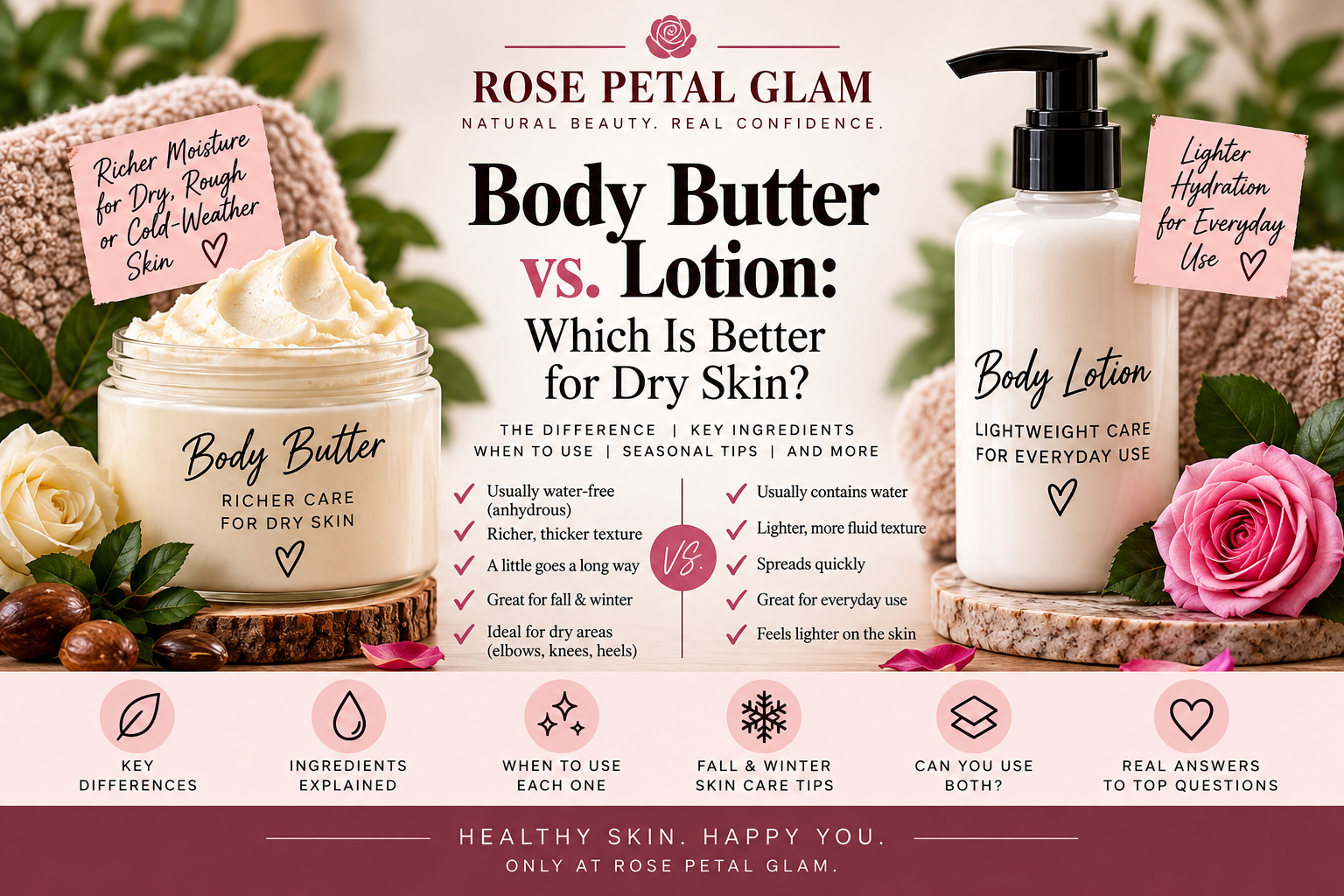
Body butter and body lotion are both moisturizers, but they are built very differently. Lotion normally contains a substantial water phase, while many body butters are richer in fats and oils—and some, including Rose Petal Glam’s whipped tallow body butter, contain no added water at all.
That difference affects texture, application, skin feel, preservation and when each type of moisturizer may fit your routine.
And as cooler fall weather arrives, understanding that difference becomes especially useful.
Quick Answer: Body Butter vs. Lotion
Choose lotion when you prefer a lighter, faster-spreading moisturizer. Choose body butter when you prefer a richer, more oil-forward moisturizer, particularly on dry-feeling areas.
Neither category is automatically “better.” The right choice depends on the actual formula, your skin, climate and texture preference.
For either type, applying moisturizer after bathing—while skin still retains some water—can be especially useful when dryness is a concern.
Body Butter vs. Lotion at a Glance
| Feature | Body Lotion | Body Butter |
|---|---|---|
| Water | Usually contains a substantial water phase | May contain less water or no added water, depending on formula |
| Texture | Usually lighter and more fluid | Usually richer and thicker |
| Spread | Typically spreads quickly over large areas | A smaller amount may cover dry areas |
| Skin feel | Often lighter | Often richer and more occlusive-feeling |
| Preservation | Water-based formulas generally require an appropriate preservation strategy | Anhydrous formulas have different microbial considerations |
| Good time to use | Any time you prefer lightweight moisture | When you prefer richer moisture, especially in cooler/drier conditions |
What Is Body Lotion?
A traditional body lotion is an emulsion.
That means it combines a water phase and an oil phase using ingredients that allow those normally incompatible materials to remain mixed.
A lotion may contain:
- Water
- Humectants such as glycerin
- Oils
- Emollients
- Emulsifiers
- Thickeners
- Preservatives
- Fragrance, if scented
The relatively high water content is one reason lotions can feel lighter and spread easily.
What Is Body Butter?
“Body butter” describes a richer moisturizer category rather than one standardized formula.
Some body butters are emulsions that contain water.
Others are anhydrous, meaning they are formulated without an added water phase.
An anhydrous body butter may be built from materials such as:
- Shea butter
- Cocoa butter
- Mango butter
- Beef tallow
- Jojoba oil
- Other cosmetic oils and waxes
Because formulations vary, you cannot determine everything about a moisturizer simply from the words “body butter” on the front of the jar.
What Does “Anhydrous” Mean?
Anhydrous simply means formulated without water.
It does not automatically mean better, safer, more natural or more effective.
It describes the formulation.
Rose Petal Glam’s whipped tallow body butter is an anhydrous moisturizer.
Its base is built around grass-fed beef tallow and jojoba oil rather than a water-based lotion emulsion.
Why Does Water Matter in a Moisturizer?
Your skin benefits from both water and lipids.
A lotion can deliver water and water-binding ingredients directly in the formula.
An oil-rich, water-free butter approaches the job differently: its fats and oils can help condition the skin and reduce the dry feeling associated with moisture loss.
That is why applying an anhydrous moisturizer to skin that is still slightly damp after bathing can make practical sense.
The shower supplies water; the moisturizer supplies the oil-rich layer.
Should You Apply Body Butter to Wet or Dry Skin?
Slightly damp skin is often an excellent time.
After showering:
- Gently pat your skin with a towel.
- Do not rub it completely bone-dry.
- Apply a small amount of body butter.
- Massage it over the areas that need moisture.
- Add more only if necessary.
You do not need to apply an enormous amount.
Why Does a Little Body Butter Go a Long Way?
A water-free body butter does not contain the large water phase found in conventional lotion.
That means virtually everything you scoop from the jar is part of the oil/fat-based product.
Starting with too much can therefore create a heavier or greasier feel than necessary.
Start small.
You can always add more.
Body Butter vs. Lotion for Fall and Winter
Cooler weather changes the environment around your skin.
Outdoor air becomes colder, indoor heating becomes more common and many people begin noticing rougher-feeling hands, elbows, knees and legs.
This is also why richer creams and body butters become especially visible in fall body-care launches.
If your lightweight summer lotion suddenly feels insufficient, you do not necessarily need to abandon it.
You can adjust your routine.
The Fall Moisturizer Strategy
| Situation | Try |
|---|---|
| Skin feels comfortable | Keep using the moisturizer you enjoy |
| Light dryness | Apply lotion more consistently after bathing |
| Rough elbows/knees | Use richer moisturizer specifically on those areas |
| You dislike heavy products during the day | Use lotion during the day and richer body butter at night |
| You prefer an oil-rich moisturizer | Try an anhydrous body butter on slightly damp skin |
Do You Have to Switch Moisturizers in Winter?
No.
If your normal moisturizer continues to keep your skin comfortable, there is no rule requiring a seasonal product change.
Change the routine when your skin gives you a reason.
That is more useful than following a beauty calendar.
Can You Use Lotion and Body Butter Together?
Yes.
You do not have to choose one category forever.
Someone might use a lighter lotion across the body and a richer butter on elbows, knees, heels or hands.
Another person might prefer lotion in summer and body butter during colder months.
Another may simply prefer body butter year-round.
Texture preference matters because a moisturizer you hate wearing is a moisturizer you probably will not use consistently.
Body Butter vs. Lotion for Rough Areas
Richer products can be particularly convenient on small areas that frequently feel rough.
Common examples include:
- Elbows
- Knees
- Hands
- Heels
- Shins
Persistent cracking, inflammation, severe itching or a diagnosed skin condition is a different situation and may require professional medical advice rather than simply switching cosmetic moisturizers.
Does Body Butter “Hydrate” Skin?
This word gets used loosely in beauty marketing.
Technically, water hydrates.
An anhydrous body butter does not contain an added water phase, so a more precise description is that its fats and oils moisturize, soften and condition the skin and can help reduce the feeling of dryness.
That is why using it after a shower is useful: you are applying the oil-rich moisturizer while your skin still contains water from bathing.
Does Tallow Make Body Butter Different?
Tallow changes the fatty composition and physical characteristics of the formula.
Rose Petal Glam uses grass-fed beef tallow as the primary fat in its whipped body butter and pairs it with jojoba oil.
That creates a different experience from a lotion built primarily around water, emulsifiers and lightweight emollients.
But we do not need to claim that tallow is magically identical to human skin or that it treats skin diseases.
It is a traditional cosmetic fat that can be formulated into a rich leave-on moisturizer.
Tallow Body Butter vs. Tallow Soap
These products contain the same broad starting ingredient but perform completely different jobs.
| Tallow Soap | Tallow Body Butter |
|---|---|
| Rinse-off cleanser | Leave-on moisturizer |
| Tallow participates in saponification | Tallow remains part of the oil/fat phase |
| Primary purpose: cleansing | Primary purpose: moisturizing/conditioning |
| Rinsed away | Left on skin |
This is why saying “our soap contains tallow, so you don't need moisturizer” would be misleading.
Soap and body butter have different jobs.
What Does Jojoba Oil Do in Body Butter?
Jojoba is technically a liquid wax ester rather than a conventional triglyceride oil.
In body butter it helps modify spread, slip and skin feel.
Rose Petal Glam pairs jojoba with tallow so the finished product spreads more easily than solid tallow alone.
Why Add Arrowroot to Body Butter?
Powders such as arrowroot can modify the sensory feel of an oil-rich product.
In Rose Petal Glam body butter, arrowroot helps reduce an excessively oily or greasy sensation.
It does not magically remove the oils.
It helps change how the finished formula feels during application.
Why Is Beeswax Sometimes Used?
Beeswax can contribute structure and firmness to an anhydrous formula.
That can become particularly useful when a product must remain stable through warmer temperatures.
But formulation is a balancing act.
Too much structure can make a butter harder to scoop and spread.
Too little can make it overly soft in heat.
This is one reason handmade body-care formulation involves more than simply mixing attractive ingredients together.
Why Water-Free Does Not Mean “No Safety Concerns”
Water activity strongly influences microbial growth, which is why anhydrous products have different preservation needs from conventional lotions.
But consumers still need to use products sensibly.
For jarred products:
- Use clean hands.
- Keep the lid closed when not in use.
- Avoid introducing shower water into the jar.
- Store according to the maker's instructions.
- Stop using a product if its appearance, odor or texture changes unexpectedly.
Does Body Butter Need to Be Fragranced?
No.
Fragrance is part of the sensory experience—not the moisturizing mechanism.
Rose Petal Glam offers scented body butters for people who enjoy fragrance layering and Gentle Clean for customers who prefer fragrance-free body care.
Why Scented Moisturizer Is Growing
Body care and fragrance are increasingly overlapping.
Instead of perfume being the only scented step, consumers are building routines with:
- Body cleanser
- Scrub
- Moisturizer
- Deodorant
- Body mist or body spray
Recent 2026 launches show this clearly, with brands extending popular scent profiles across cleansers, lotions, oils and other body products.
Vanilla Is a Perfect Example
Vanilla body care is having a particularly strong moment.
A newly launched 2026 vanilla body-care collection built around vanilla bean, coconut cream, caramel, pistachio and salt reportedly became its brand's biggest launch, with its hero lotion nearly selling through within 24 hours.
That tells us something useful:
People increasingly want moisturizer to do more than feel functional—they want to enjoy the fragrance experience too.
Fragrance Layering With Body Butter
If you enjoy scented body care, body butter can become the middle step of a fragrance routine:
Cleanse → moisturize → deodorant → finishing fragrance.
Matching scents can make the routine feel more cohesive.
That does not mean we should promise a specific number of fragrance hours.
Fragrance longevity depends on the formula, amount used, skin, clothing, environment and fragrance materials.
How Rose Petal Glam Makes Whipped Tallow Body Butter
Rose Petal Glam handcrafts its body butter in small batches in Mount Morris, Michigan.
Our current formula is built around:
- Grass-fed beef tallow
- Jojoba oil
- Beeswax where used for structure
- Arrowroot powder
- Kaolin clay
- Fragrance oil in scented varieties
Our body butter is water-free.
That makes it fundamentally different from a conventional water-based lotion.
Which Rose Petal Glam Body Butter Should You Choose?
If fragrance is part of your decision, choose the scent family that fits you.
Rose Petal Glam currently makes body-care profiles ranging from:
- Fragrance-free Gentle Clean
- Airy vanilla
- Fruity candy
- Bakery-inspired gourmands
- Fresh aquatic men's scents
- Woody and spicy men's fragrances
The moisturizer underneath still has the same basic job:
help skin feel softer, smoother and more comfortable.
Body Butter vs. Lotion: The Bottom Line
Lotion and body butter are not competing teams.
They are different moisturizer formats.
Lotion usually provides a lighter, water-rich emulsion.
Body butter usually provides a richer, more oil-forward experience.
An anhydrous tallow body butter goes one step further by eliminating the added water phase entirely.
Choose based on:
- Your skin
- Your climate
- Your texture preference
- Where you're applying it
- Whether you want fragrance
- And what you'll actually use consistently
The best moisturizer is not necessarily the one with the trendiest ingredient.
It is the one that fits your routine and leaves your skin feeling comfortable enough that you want to keep using it.
Explore Rose Petal Glam's handcrafted whipped tallow body butters and find your fragrance—or choose Gentle Clean when you want no added fragrance.
Smell Good. Feel Confident.
Frequently Asked Questions
What is the difference between body butter and lotion?
Lotion is generally a water-and-oil emulsion with a lighter texture. Body butter is typically richer and more oil-forward; some body butters, including Rose Petal Glam's whipped tallow body butter, contain no added water.
Is body butter better than lotion?
Not universally. Body butter may appeal to people who prefer richer moisturizers, while lotion may be preferable when a lighter texture is desired.
When should you apply body butter?
After bathing is an excellent time, particularly while the skin is still slightly damp. Start with a small amount and add more where needed.
Can you use body butter every day?
Body moisturizer can generally be used according to your skin's needs and the product directions. Reduce or stop use if a product causes irritation or breakouts.
Can you use body butter and lotion together?
Yes. For example, you can use lotion broadly and reserve richer body butter for particularly dry-feeling areas.
Does body butter contain water?
Some does and some does not. “Body butter” is not one standardized formula. Check the ingredient list. Rose Petal Glam's whipped tallow body butter is water-free.
Is body butter good for winter?
People often prefer richer moisturizers during colder, drier weather, particularly on rough-feeling areas. Individual skin needs still vary.
Why should body butter be applied to damp skin?
A water-free butter does not supply an added water phase itself. Applying it after bathing lets you use the rich moisturizer while water from the shower is still present on and in the outer skin.
Does Rose Petal Glam body butter contain beef tallow?
Yes. Rose Petal Glam's whipped body butter is formulated with grass-fed beef tallow. Rose Petal Glam's body sprays are the exception in the broader product lineup and do not contain tallow.
Where is Rose Petal Glam body butter made?
Rose Petal Glam handcrafts its body butter in small batches in Mount Morris, Michigan.
Sources & Further Reading
- U.S. Food & Drug Administration — Cosmetics Labeling Claims
- U.S. Food & Drug Administration — Cosmetics Labeling
- European Wax Center — Golden Orchard Body Butter & Body Polish Launch, September 2, 2026
- Current Fall 2026 body-care and moisturizer coverage
This article provides general cosmetic and body-care information and is not medical advice. Persistent, severe or unexplained skin problems should be evaluated by an appropriate healthcare professional.